


2.2.1 Campus food waste tracking
Dokuz Eylül University · THE Sustainability Impact Ratings 2027 · SDG 2 Zero Hunger
Dokuz Eylül University · THE Sustainability Impact Ratings 2027 · SDG 2 Zero Hunger · Metric 2.2 Campus food waste
2.2.1 Campus food waste tracking
| Indicator | 2.2.1 Campus food waste tracking |
| THE question | Measure the amount of food waste generated from food served within the university. |
2.2.1.1 Statement
Dokuz Eylül University rigorously measures and tracks the amount of food waste generated from catering and food services operated across its campuses through an integrated reservation-based meal production system, mandatory recorded disposal protocols for unserved food, and structured seasonal weighing campaigns, publishing verified findings annually in its institutional sustainability reports.
2.2.1.2 Scope of the measurement
Meals are prepared in two large-scale university-run production kitchens: the Central Kitchen located on the Central (Tınaztepe) Campus and the Faculty of Medicine Kitchen located on the 15 Temmuz Health and Art Campus in İnciraltı. Together, these facilities cater to 17 campus dining halls with a total seating capacity of 4,390 students and staff. In calendar year 2025, university-run dining halls served a total of 893,185 student meals (comprising 25,256 free means-tested scholarship meals and 867,929 paid meals). Food waste measurement comprehensively encompasses this entire university-run mass catering operation. Commercial retail outlets (26 canteens and 37 cafeterias, of which 20 canteens and 35 cafeterias are leased to private operators under State Tender Law No. 2886) are subject to contractual food safety rules and are progressively being integrated into institutional weighing campaigns.
2.2.1.3 How food waste is measured and managed
2.2.1.3.1 Prevention at source via smart-card meal reservations
Students and university employees reserve their daily meals in advance through the automated smart-card meal management portal (pos.deu.edu.tr). Pursuant to Article 12 of the Senate-approved Directive on the Operation of Nutrition Services, the Directorate of Nutrition Services tracks reservation figures, turnstile swipe counts, preparation quantities, and actual consumed portions. Kitchen teams adjust ingredient preparation daily based on these digital forecasts, effectively eliminating unnecessary mass overproduction.
2.2.1.3.2 Recorded disposal of unserved food
Under Article 19 of the Directive on the Operation of Nutrition Services, any unserved food that cannot be safely stored or redistributed according to food safety codes must be recorded in writing before disposal. Kitchen supervisors prepare official logs detailing exact meal types, portion counts, and weight, which are submitted for departmental audit and environmental accounting.
2.2.1.3.3 Dining hall plate-waste weighing campaigns
In 2024, the Sustainable Waste Management Student Community conducted the ‘What’s on My Plate?’ field study, weighing post-consumer plate waste in four central dining halls over a ten-day period and extrapolating findings across total annual meal counts, resulting in an estimated 26.1 tonnes of dining hall food waste for 2024. During the May 2025 – April 2026 reporting cycle (GreenMetric Report DEUSR 26), periodic sampling yielded an estimated 22.5 tonnes across all facilities (equivalent to approximately 16 tonnes for calendar year 2025).
2.2.1.3.4 Composting of kitchen organic waste
Organic food preparation scraps (peels, trimmings, vegetable residues) are segregated at the source in university kitchens. In May 2025 – April 2026, 8.3 tonnes of pre-consumer organic waste were processed in campus composting machines (representing about 37% of total kitchen organic output), following 9.2 tonnes composted in 2024.
2.2.1.3.5 Waste vegetable oil collection and recycling
In compliance with Article 20 of the Directive, used cooking oils from campus fryers and kitchens are collected in dedicated leak-proof drums and delivered to licensed environmental recycling firms for biodiesel production: 5,125 kg were collected and recycled during the May 2025 – April 2026 cycle, up from 4,140 kg in the previous reporting period.
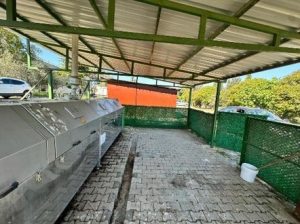
Figure 1: Industrial composting machine in operation at DEU campus facilities, processing organic kitchen preparation waste from central dining halls.
2.2.1.4 Institutional reporting and quality monitoring
Waste metrics are audited and consolidated by the Zero Waste and Environmental Management Coordination Office and the Sustainability Office, published annually in the University’s GreenMetric Sustainability Reports. All 15 DEU campuses hold official Zero Waste Certificates, successfully renewed in 2025–2026 and valid until 2031. All food waste reduction and social contribution actions are tracked within KALBİS, DEU’s integrated quality management portal, under continuous Plan-Do-Check-Act (PDCA) quality assurance cycles.
2.2.1.5 Quantitative data
|
Item |
2024 |
2025 |
Unit |
| Student meals served in university dining halls |
1,310,366 |
893,185 |
meals |
| Estimated total food waste (campus dining halls) |
26.1 |
16.0 |
tonnes |
| Kitchen organic preparation waste composted |
9.2 |
8.3 |
tonnes |
| Waste vegetable oil sent for licensed recycling |
4,140 |
5,125 |
kg |
2.2.1.6 Responsibility and verification
-
Responsible Units: Department of Health, Culture and Sports (SKS) – Directorate of Nutrition Services; Zero Waste and Environmental Management Coordination Office; Data Management Coordination Unit.
-
Contact Email: deu.veriyonetimi@deu.edu.tr · sifiratık@deu.edu.tr · sks@deu.edu.tr
-
Regulatory Basis: Directive on the Operation of Nutrition Services (Beslenme Hizmetleri İşletim Yönergesi), approved by DEU Senate Decision No. 633/05 on 10 March 2023.
2.2.1.7 References
Dokuz Eylül University, Department of Health, Culture and Sports. (2023). Beslenme Hizmetleri İşletim Yönergesi [Directive on the Operation of Nutrition Services] (Senate Decision No. 633/05, 10 March 2023).
Dokuz Eylül University, Department of Strategy Development. (2026). 2025 yılı idare faaliyet raporu [2025 administrative activity report]. Dokuz Eylül University. https://strateji.deu.edu.tr/wp-content/uploads/2026/03/Dokuz-Eylul-Universitesi-2025-Yili-Idare-Faaliyet-Raporu.pdf
Dokuz Eylül University Sustainability Office. (2025). Dokuz Eylül University sustainability report 2024–2025 (GreenMetric Report DEUSR 24-25). DEU Green Campus. https://greencampus.deu.edu.tr
Dokuz Eylül University Sustainability Office. (2026). Dokuz Eylül University sustainability report 2025–2026 (GreenMetric Report DEUSR 26). DEU Green Campus. https://greencampus.deu.edu.tr
Times Higher Education. (2026). THE Sustainability Impact Ratings 2027: Methodology (Version 1.0). Times Higher Education.
2.2.1 Campus food waste tracking · Dokuz Eylül University